
To view graphic version of this page, refresh this page (F5)

Skip to page body
  • go to google translator
  • contact us

Code Enforcement Program: Survey Analysis Report


Projects & Reports

Citywide Policy Reports

Code Enforcement

Dwelling Unit Merger

Historic Preservation

Housing Element

Implementation Reports

Industrial Protection Zones

Inner Mission North

Residential Demolition

Residential Design

Zoning Administrator

REPORT ON SAN FRANCISCO NEIGHBORHOOD

SURVEY ON CODE ENFORCEMENT ISSUES

San Francisco Planning Department

November 18, 1999

TABLE OF CONTENTS

I. Code Enforcement Survey Background.................1
II. City-Wide Findings................................3
III. Specific Concerns by Neighborhood Quadrants......6
>>Southwest
>>Northwest
>>Southeast
>>Northeast
Attachments:
A. List of Responding Organizations
B. Copy of Survey Form
C. Summary of Responses to Open Ended Questions by Quadrants
Acknowledgments

I. CODE ENFORCEMENT BACKGROUND

Why the survey was developed

The Board of Supervisors and Planning Commission recognized from public testimony on the Department budget and work program and responses to a past Neighborhood Issues Survey that Code Enforcement is of major concern to many neighborhoods. During the last six years, the Department did not have staff assigned to Code Enforcement. The Zoning Administrator handled a few complaints on a time available basis. Due to budget constraints, Neighborhood planners assisted only on a very sporadic basis.

Responding to this concern, the Planning Commission and Department sought and received increased staff resources for this activity. In the current fiscal year (FY 99-00), the City budget provides that each of the Planning Department's four geographic Neighborhood Planning areas will have the equivalent of approximately one full time Code Enforcement position. The Board of Supervisors Finance Committee, in its review and oversight of the budget, encouraged the Department to get direct input from neighborhood residents and merchant groups on their priorities. The intent was to help shape the program to be responsive to the Code Enforcement problems most prevalent in particular neighborhoods.

Outreach for advice on survey content

Department staff asked Planning Commissioners, those receiving the Planning Commission agenda, and the people testifying at the Board of Supervisors Finance Committee about Code Enforcement to review an early draft of the survey. A work session was also held with the land use subcommittee of the San Francisco Coalition of Neighborhoods. Comments from groups and individuals resulted in addition of several questions and refinement of the overall survey.

Fielding the survey

On October 13, 1999 the survey was mailed to the 400 organizations listed in the Department's Neighborhood Organization list, requesting a response by November 1. Follow up phone calls were made to the largest, most active groups in each Neighborhood quadrant to try to insure broad geographic coverage of responses. The Department received 57 responses, including eleven that were received too late to code electronically. This is a return rate of about 14% in relation to the list, but probably closer 20% in terms of active neighborhood groups.

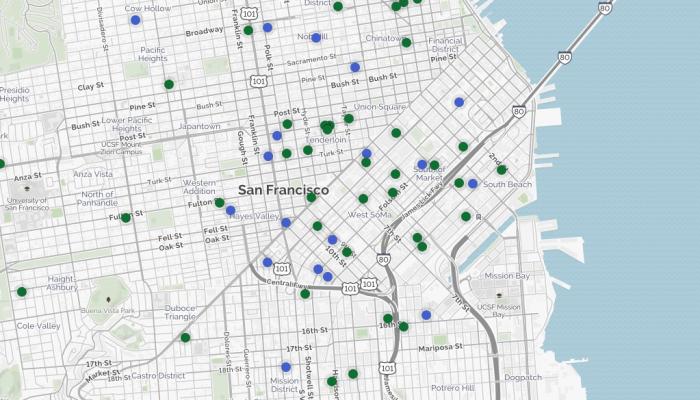
MAP SHOWING AREAS RESPONDING

(being produced)

II. CITY-WIDE FINDINGS

A. Types of Violations Abatement Rated as Having Highest Priority or Great Importance

The highest percentage (77%) of responding neighborhood organizations gave high priority or great importance to enforcing Conditions of Approval for projects approved by the Planning Commission or for variances granted by the Zoning Administrator. Respondents may have been aware of pending legislation that clarifies and reinforces the ability of the Commission to institute revocation hearings for previously authorized Conditional Use permits where compliance with conditions is an issue. Conditions of approval have often reflected the recommendations of neighborhood organizations or other concerned parties in the vicinity of the project.

The second highest percentage (66%) for high priority or great importance was attributed to insuring that residential demolition permits go through required procedures and give neighborhood notice. About two-thirds of Neighborhood Organizations (32) feel this is a critical issue.

Code enforcement for illegal units in new construction was ranked as high priority by 54% of the Neighborhood Organizations. Enforcement against older illegal units was of major concern to a lesser percentage, 40%.

Commercial uses in residential areas and nuisances from commercial uses in commercial zones were of major concern to less than one third of the organizations.

There were strong differences in particular quadrants from the Citywide results, as will be outlined below.

B. Comparison with 1992 Planning Commission Priorities

Code Enforcement priorities were established by Commission action in 1992. Mary Gallagher, who is now Zoning Administrator, was then the Code Enforcement Unit Manager. The staff developed these priorities from the General Plan and Planning Code. A further factor in 1992 was the impact of the violation - e.g. the number of people affected. The 1999 responses by neighborhood organizations indicate that life safety and degradation of neighborhood quality are still very highly ranked violation issues. Neighborhood organizations are now more deeply concerned about non-compliance with conditions of approval from the Planning Commission, the Residential Design Guidelines or with approved building permits. The lowest priority given was in the business sector where loss of jobs may be involved.

C. Impacts Associated with Violations

The survey asked neighborhood organizations to check which of six potential life style impacts led them to their highest priority for Code Enforcement. The most predominant concerns checked were potential impacts related to crime, property values and parking.

D. Relative Importance of Sources/Volume and Recency of Complaints

Neighborhood organizations ranked the relative importance of source of complaints from neighborhood organizations themselves as the most important. A close second was complaints from many members of the public. Whether many complaints were about a single owner was of slightly less importance.

A violation affecting many people in a significant way was seen as slightly more important than one affecting a few people in a very significant way.

The timing of complaints did not seem too critical to neighborhood organizations. The number of people giving primary importance to recent complaints was about equal to the number giving primary importance to long-standing complaints (five years or more) . This may reflect the relative neglect by the Planning Department of Planning Code violation abatement during the past seven or eight years.

E. Opinions on Need for Administrative Penalties

As explained in the survey, under the current laws, penalties for violation of the Planning Code can only be imposed by the Courts, thereby limiting the volume of enforcement activity. Enactment of legislation would be needed to empower the Planning Department to levy administrative penalties for Planning Code violation. The Department of Building Inspection has the ability to issue Notices of Violation of the Building Code and have Administrative Hearings known as Director's Hearing. This process allows the Department of Building Inspection to impose penalties and recover costs related to enforcement activities.

Support for considering such legislation was strongly expressed in the survey by 80% of the neighborhood organizations representing residents. The other 20% did not have an opinion. They wanted further information on such legislation. Of the five neighborhood organization representing merchants, two supported the need for administrative penalties, one did not and the others had no opinion.

F. Issues of Most Local Concern

On the open-ended question asking Neighborhood Organizations to describe the issues of greatest concern to them in terms of Code Enforcement, responses fell into several distinct categories and tended to be rather broad in scope. Respondents tended to blur the distinction between compliance (applying the Code and design guidelines to pending projects) to Code enforcement (abating violations in projects that have already been approved). However, because concerns about perceived gaps in compliance were so often mentioned, these responses have been summarized in Attachment C as well.

Broad categories of concern included:

" Inadequate application of Residential Design Guidelines and/or need for stronger guidelines in commercial and industrial areas

" Illegal residential units

" Conflicts with both authorized and illegally-converted commercial activities

" Frustration with specific projects such as school expansions, chain stores, Sutro Tower, etc.

" Inadequate effort/response to Code Enforcement complaints by Building Inspection and Planning Departments.

These issues will be further described for each quadrant in Attachments to this Report.

G. Need for public information and education on Planning Regulations

On the question about neighborhood organizations' satisfaction with how the Planning Department provides information about what the Planning Code allows in their neighborhoods, about 60% were not satisfied. Suggestions included more use of the Internet, sending staff to talk to neighborhood organizations, preparing simple handbooks for the use of public and neighborhood groups, including more background on regulations with standard notices, and having less waiting time for the telephones at the Department's Planning Information Counter.

About 27% of the respondents felt there is provision of sufficient information to neighborhood organizations to allow them to identify violations. The remaining 13% had no opinion.

III. SPECIFIC CONCERNS BY NEIGHBORHOOD QUADRANTS

Responses were also compiled by Neighborhood Quadrant. Current Quadrant boundaries which will soon be modified slightly (the Haight will become part of the Northwest) are indicated on the following map. The extent of response varied in the four quadrants. The greatest number of responses (25) were received from organizations in the Southwest, the most extensively residential quadrant in the City. Fourteen responses were received from the Northwest.

On the eastern side of the City, eleven responses were received from the Southeast and only five, plus one letter from the Northeast. To achieve a wider geographic coverage on the East side, surveys were supplemented by telephone calls to some of the larger groups that had not responded. Two responses came from Citywide groups representing tenants.

The following desribes ranked responses by quadrant. Ideas expressed by respondents are summarized in an attachment to the report.

Southwest

In the Southwest quadrant, in contrast to 31% of Citywide responses, the enforcement issue ranked as most serious by 75% of the responding organizations was commercial uses in residential districts. SW associations concurred with the Citywide ranking that enforcing conditions of approval for projects authorized by the Planning Commission or Zoning Administrator is critical. Priority ranking of enforcement related to illegal units, both in new construction, and preexisting in older buildings was proportionally higher than Citywide by about 10% in the Southwestern quadrant. Concern with the demolition process was slightly lower (63%) than the Citywide percentage (66%).

Northwest

In the Northwest quadrant, organizations ranked commercial use enforcement issues much higher than the rest of the City. Approximately three fourths of the organizations gave highest priority or great importance to commercial uses in residential districts and to commercial uses causing nuisances in commercial districts. This is double the percentage of the Citywide responses. Organizations in this quadrant did concur with the Citywide ranking related to new and existing illegal units. They gave even more emphatic emphasis (90% v. 77%) to the need to enforce Conditions of Approval as well as to the need to enforce demolition controls.

Southeast

In the Southeast, most organizations gave very high rankings to commercial uses in residential districts and problems with nuisances from commercial uses in commercial districts. Almost 90% of the organizations considered the highest priority or issue of greatest importance to be illegal commercial uses in residential areas. The issue of nuisance from commercial uses in commercial districts was similarly ranked as more important than in any other part of the City (85% v. 29%). The organizations in this area also made the strongest distinctions between new and older existing illegal residential units. Only one quarter of responding organizations would give priority or importance to older existing illegal housing units while citywide this priority was 40% . Concern with newer illegal units was slightly higher, however, than the Citywide percentage. Organizations from this area had less priority (64%) for enforcement related to Conditions of Approval than did other parts of the City (77%).

Northeast

Northeast groups responding to the written survey gave no priority to the question of illegal units, either new or pre existing. Telegraph Hill Dwellers noted that the issue of illegal units is a legislative matter, not a matter for determination by public opinion. Most priority centered on problems from commercial uses in commercial districts.

ATTACHMENT A - LIST OF RESPONDING ORGANIZATIONS

List of Responses Received After November 8, 1999

North Beach Neighbors NE

Telegraph Hill Dwellers NE

Cole Valley Improvement Assn NW

Lake Street Residents Assn NW

Save our Richmond Environment NW

Bernal Heights E. Slope Des. Rev. Bd SE

Northwest Bernal Alliance SE

South Bernal Action Alliance SE

Southeast Mission Neighborhood Assn. SE

Excelsior Merchants SW

OMI Neighbors in Action SW

ATTACHMENT C - SUMMARY OF OPEN ENDED RESPONSES ON ENFORCEMENT CONCERNS BY QUADRANT

Southwest Quadrant

Improving compliance with the Residential Design Guidelines was important to Friends of Noe Valley, Lakeshore Acres Improvement Club, Monterey Heights Homes, Miraloma Park Improvement Club, Sherwood Forest and St. Francis Wood. Lakeshore Acres had problems with  additions to existing homes where additions do not conform to the design of existing homes . Miraloma Park wanted  vigorous design review . Sherwood Forest wrote  The real enforcement issue that the Planning Department has issued building permits (residential) that shouldn't be issued. Homes on steep hillsides that undermine the integrity of the land . OMI Neighbors in Action said  The OMI needs an urban design plan to direct design of new construction and renovation activity such as replacing windows. New buildings that look cheap-suburban do not help revitalize the neighborhood. Much of the bad renovation work is done without permits -- commercial window contracts seem to be the worst offenders .

The Cayuga Improvement Association, Excelsior District Improvement Association, Eureka Valley Promotion Association, Forest Hill Association, Outer Mission Residents Association and Twin Peaks Council all cited illegal residential units as a major problem. Excelsior described  multiple families living in single family homes, all with cars. There is a house on Lisbon with unrelated families living in it -- garage, attic, main floor, and the shack in back with no plumbing . Outer Mission wrote  It is dangerous to have illegal units which have never been inspected by the Building Inspection Department. The disrespect of the surrounding neighbors, the parking spaces being used up on the streets, the City services utilized by the occupants of the illegal units which they do not pay for and the taxes that are not collected. This reminds one of not filling out census forms when mailed out. If people fail to fill out the census , services cannot be provided adequately because the government is not aware where and when they are needed .

OMI Neighbors in Action and OMI Community Action Organization stressed problems with construction activity without building permits.  Building activity creating illegal and unsafe unit without permitting - or supposed single family houses permitted, for say, 5 bedrooms and 5 bathrooms in a single family zone. Illegal building is more prevalent than legal building around here .

Excelsior Merchants, Geneva-Mission, Noe Valley merchants and Professionals, No Courts, Cayuga, and Upper Noe Neighborhood described problems with commercial development. For Geneva-Mission it is the condition of empty store fronts. For the other organizations, it is generally either that commercial uses such as auto repair intrude into residential areas (Cayuga) or that they felt (Noe Valley Merchants)  the commercial space larger than 2500 square and large commercial concerns will impact the Neighborhood Commercial District regarding parking, congestion and the deterioration of our unique commercial district. This view is shared by Upper Noe Neighbors and Excelsior Merchants which emphasized the need to preserve small businesses. Environmental enforcement (noise, odor, sidewalk obstruction) is mentioned by Friends of Noe Valley.

Some Neighborhood Organizations identified specific projects that may have had recent Conditional Use authorizations as being enforcement concerns. For Eureka and 17th Neighbors, this was a live work project at 17th and Market which is now proposed for another use. For Midtown Terrace, Sutro Tower structural issues were described. Twin Peaks had concerns about the Rooftop School expansion and Little Hollywood about the Garbage Company operations.

Friends of Noe Valley, Little Hollywood, Miraloma Park, Noe Valley Merchants, Outer Mission, OMI and Westwood Highlands expressed frustration with the inadequacy of the Planning Department's existing Code Enforcement efforts. Friends of Noe Valley stressed the importance of  implementing effective working relationships between Planning and Department of Building Inspection (building permits); Planning and DPW (sidewalk obstructions) and Planning and the Health Department (noxious odors). Little Hollywood suggests there be a  hotline of some kind to allow people to complain and get a quick response . Outer Mission says,  it seems to this community, that when we do pose concerns with either the Planning Department, Zoning Administrator or the Planning Commission, we are the ones who have to prove themselves and not the above-mentioned agency department or property owners applying for permits or property owners with illegal units. We are the bad guys. That is not the way it should be. We look forward to working with the Planning Department to have better community relations .

Northwest Quadrant

Alamo Square Neighborhood Association, Cow Hollow Association and North of Panhandle Neighborhood Association criticized Design Review procedures. Alamo Square expressed need for  Historic District Guidelines in changing existing structures or make ill-guided improvements to them . Cow Hollow stressed need for  adherence to Prop M and adherence to Residential Design Guidelines and Character Districts and advocated the Department  assist the neighborhoods who cannot draft their own Residential Character Districts with guidelines of development specific to that neighborhood that best defines their neighborhood character . Similarly, North of Panhandle stated  The development of a Master Plan with design guidelines would have the greatest positive impact on this neighborhood. Implementation would likely include code enforcement re commercial and residential uses. Lincoln Park Neighborhood Association said that without Design Review, you have Richmond Specials and incremental demolitions.

Illegal residential units are a problem to the Richmond Community Association, which at the same time strongly supported preservation of existing sound housing  that is more affordable than the expensive new housing that is created. RCA writes  Illegal units, so often substandard add value to the buildings while adding low quality degraded housing. It deflects from honestly addressing the need for well-planned residential development. Illegal unit affordability is a myth and the familiar phrase  in law unit' is even less true. Ninety percent do not have relatives in them. Let's get honest about up to Code, decent, safe, affordable housing. RCA adds  We see many scofflaw landlords, owners, developers and real estate speculators profit at the point of sale by selling  unwarranted in law units which have had tenants vacated prior to sale. It is easy, very easy, to track these illegal apartments simply by using local publications that advertise these types of unit with a superficial legal disclaimer phrasings. These units should be prioritized, particularly when vacant for strict enforcement of density. Because of the extra, illegal units/ these buildings are unfairly priced higher for potential buyers who do not want to keep the illegal unit(s) yet must pay a premium and also risk being  busted if the try to keep the illegal apartment. What a mess! Cole Valley states succinctly:  illegal is illegal!

The Union Street Association attached a 1997 letter to their survey suggesting that particular questions about illegal units, including an inventory of existing units, displacement impacts and traffic and density analysis, be included in an Environmental Impact Report being prepared on amnesty legislation pending at that time.

Lincoln Park Homeowners felt that  runaway density both legal and illegal is a major concern to them. Save our Richmond Environment also has a major concerns with  demolition/construction to increase density without proper review and permitting. Lack of tie in with transportation. Development permitted with no transit impact study that would include parking and public transportation requirement. Panhandle Residents on the other hand, felt illegal units are not an issue  unless tenant safety is at risk .

Commercial use problems were described by Alamo Square, Lincoln Park Homeowners, Panhandle Residents and Union Street Association. Alamo Square noted problems with automotive repair businesses and the  gross industrialization of commercial business on Divisadero Street in violation of conditional use permits . Lincoln Park said nuisances from non permitted commercial activities are  a real threat to the peaceful coexistence of mixed uses . Panhandle Residents expressed concern with  Residential properties being converted to commercial use without proper permits or public notification. Union Street Association had problems with conditions of approval for conditional use not being followed by applicants and is frustrated by facade changes done without permits that alter older buildings.

In terms of adequacy of the Planning Department's existing code enforcement work, the Lincoln Park Homeowners was very dissatisfied.  The Planning Department has a poor reputation and little credibility. They have earned that reputation by not enforcing the Code and looking the other way for lobbyists, residential builders, etc. If you want credibility -- enforce the Code as written . North of Panhandle advised  It is time for this City Administration to place neighborhood livability as a top priority for staff time and labor. Neighborhoods are suffering by inadequate planning vision and enforcement .

Save our Richmond Environment wrote:  First, the Department should determine promptly if something that has been brought to their attention merits action. By promptly assessing a situation, even if abatement is not immediate, at least the residents can develop greater confidence in the process. Presently the Department apparently sucks up complaints into a vortex that produces nothing .

Southeast Quadrant

The Potrero Boosters urged stronger Design Guidelines in both residentially and industrially zoned areas to address projects that are out of character, out of scale and lack open space. They also recommended a number of zoning changes to tighten regulations on self storage, transit and other fees and affordabilty requirements. The Northwest Bernal Heights Design Review Board expressed frustration with bypassing of the local design review board as required in the Bernal Heights Special Use District and with builders who do not submit accurate plans so the Association has to call the Building Inspectors to have illegal buildings stopped. The Bayview Hill Neighborhood Association said they wanted  advice and consent meetings on all new construction, particularly if density, parking and height variations are considered . Northwest Bernal complained  Builders have already abused the intent of size and construction. Why bother to approve without enforcement? Bernal Heights East Slope Design Review Board cited as problems:  overbuilding -- beyond the maximum allowed, i.e. building into backyards, added parapet or deck. Curb cuts and garage doors wider than guidelines allow -- eliminates parking and adds to congestion on the street. A further observation on design review by Bernal Heights East Slope was  When major changes are made to approved plans, there should be a notification system set up for neighborhood groups.

The Southwest Mission Association polled a number of people on their concerns which tended to be quality of life issues more than Planning Code enforcement problems. Problems mentioned included drugs, robbery, traffic, high speeds in autos, noise, trash and vandalism, and parking. Some specific locations were described. One respondent urged that to legalize and encourage extra units, side by side parking requirement should be liberalized.

Friends of Islais Creek expressed problems not so much with illegal units, but with live in vehicles parked in the streets and camping on open space lots. Northwest Bernal Alliance wrote  As rents skyrocket, more people take their businesses home with them. Parking of commercial vehicles overnight is a problem. Rotation of  vehicles in storage' is also a problem .

Commercial use problems were described by 700 Block of Capp Association. These include  noise from commercial activities that persist long after they are legally allowed . They added  We often suffer because of lack of enforcement of a bar providing liquor to intoxicated clients. They come out of the bar and urinate and vomit at our outdoor steps. The Bayview Hill Neighborhood Association is frustrated with  the practice of auto repairs on our streets with little or no enforcement even when reported and also with  single family residences becoming boarding houses without license or approval .

Dissatisfaction with existing levels of Code Enforcement by the Planning Department is echoed by 700 Block of Capp which wrote:  We depend on various government agencies to do the job they were assigned. The existing laws and code should be enforced. We have to make repeated phone calls in order to get a response to various code violations, and then nothing happens. Lower Potrero Hill said  Enforce the Codes in all aspects. Levy high fines that will pay for the time spent on enforcement. Don't put all the financial and enforcement pressure on the homeowners who do take out permits and play by the rules. Enforce rules with bigger developers who seem to get to fudge a lot of thing that the single homeowner would not be able to do. Equal Enforcement . Northwest Bernal stated:  Builders must be required to remove and rebuild violations they've created .

Northeast Quadrant

Design Guidelines and illegal units are not primary issues to responding organization in this quadrant. Most represent tenants. The 1550 Bay Street Tenants Association said  The members of this tenants association are keenly and personally aware of the shortage of housing in San Francisco. Illegal units provide necessary housing . Chinatown Community Development Center wrote  We are concerned about the displacement of low income tenant currently living in units that might be illegal. We have seen cases where owners have tried to evict long term tenant from their units because the owner wanted to convert the units. Therefore, instead of trying to  legalize' these units so tenants can stay, the owner would use the City enforcement citations to get tenants out. Any enforcement needs to insure that low income tenants will be sufficiently protected.  Conversions to rental housing into other uses (i.e. condominiums, commercial, etc) where owners are utilizing the Ellis Act to evict tenants from their buildings was described as a major issue for the Chinatown Community Development Center. Once the tenants are out, these owners try to convert the buildings to other uses. The City needs to regulate the extent that owners can convert buildings where tenants have been forced out . The 1550 Bay Street tenants described one of their major concerns as loss of rental housing through restriction of rentals to only furnished and short term units.

Problems related to commercial activities were identified by Cameron House as  businesses whose displays encroach into pedestrian sidewalks, double parking, dirty, slippery, slimy sidewalks. (This issue would appear to be one in which a number of City agencies should be involved). 1550 Bay Street tenants expressed concerns with chain stores replacing unique businesses and excessive signage. The Telegraph Hill Dwellers identified an issue of great concern to them as  commercial establishments in the North Beach Neighborhood Commercial district which appear to be doing business without getting Conditional Use or other required approvals . They also note that sign ordinances are not being enforced and Planning Code provisions prohibiting storefronts from being covered by metal closures are not enforced. The North Beach Chamber of Commerce also stated a concern with billboards and notes  there are several billboards that do not comply with planning code regulations .

Telegraph Hill also had problems with  staff reports that are inaccurate in terms of project descriptions and contain inaccurate descriptions of applicable code provisions and planning requirements. This misleads the public as well as members of the Planning Commission. Telegraph Hill recommends that Planning Department staff should more carefully review the applications and submittals made by project proponents for accuracy and to be sure to perform independent review before sending out project notices to the public or preparing case reports. North Beach Neighbors noted that  There seems to be little interest in enforcing conditions in conditional use permits and variance decisions and the code requirements of the North Beach Neighborhood Commercial District . They expressed further exasperation by writing  Our organization is not clear about the purpose of this survey. Our understanding is that the Code is law and we didn't know a body, either governmental or civic, was supposed to chose which laws are supposed to be enforced. Are we to obey the speed limit but choose to run red lights? The North Beach Chamber of Commerce wrote  The biggest frustration for all of us is the general public's attitude that it doesn't matter what you do or complain about because the planning department will not enforce it due to lack of staff and funds. It would be splendid that when we notice a violation we have a simple system for reporting the supposed violation to the planning department with some reasonable assurance that the matter will be enforced .
ACKNOWLEDGMENTS
This report was prepared by the Neighborhood Planning Tactical Team with

assistance from planners in other units of the Department.,

Larry Badiner, Chief of Neighborhood Planning, provided oversight.

Neighborhood Planning Team Leaders reviewed survey draft and results:

Delvin Washington, Southwest

David Lindsay, Northwest

Angelica Chiong, Southeast

Jim Nixon, Northwest

Lois Scott, Tactical Team, developed and analyzed the survey.

May Fung, Tactical Team, assisted with outreach.

Paul Lord, Information Services, designed Paradox data entry and compilation formats.

Roger Herrera, Special Projects, provided Arc View mapping.

ATTACHMENT B - COPY OF SURVEY FORM

 
Last updated: 5/6/2010 4:08:31 PM