
San Francisco Shoreline Adaptation Plan
The San Francisco Shoreline Adaptation Plan (Shoreline Plan) will guide how we prepare our coastline for sea level rise and related challenges such as flooding during high tides and storms. Building on past and ongoing efforts, and focusing on the most vulnerable areas, the Shoreline Plan will help ensure that our waterfront remains safe, accessible, and thriving for generations to come.
Study Area
San Francisco’s shoreline is diverse. It includes wide beaches and dunes, steep cliffs, narrow coves, parks, and wetlands. The City’s shoreline also includes homes, industrial areas, and infrastructure (e.g., bridges, transit facilities, and water and wastewater pipelines).
Overview
Sea levels are rising, and San Francisco needs a proactive, comprehensive approach to protect its shoreline. Many residents have already experienced flooding during high tides and storms such as in their basements and along city streets. As recently as January 2026, high tides drenched roadways along the Embarcadero, which affected travel and access to this important corridor. Without coordinated action, approximately 10% of the city, including neighborhoods, parks, and critical infrastructure could face frequent flooding in coming years.
California State Senate Bill 272 (2023) requires coastal communities to prepare a sea level rise adaptation plan by January 2034. The Shoreline Plan will satisfy regulatory requirements from both the Bay Conservation and Development Commission (BCDC) on the bay side and the California Coastal Commission (CCC) on the ocean side. This effort will help safeguard the city’s coastal access, essential services, and long-term resilience.
The Shoreline Plan will:
- Identify communities and critical infrastructure vulnerable to sea level rise along the ocean and bay shoreline.
- Build on existing efforts and standardize the level of planning along the entire shoreline.
- Prioritize equity by centering the needs of environmental justice communities most affected by coastal flood risk.
- Work with communities and technical experts to create adaptation strategies that can evolve as conditions change.
- Create an implementation plan that outlines the policies, land use, and funding needed to enact the plan.
Timeline
The planning process will span from 2026 to 2028.
2026
- Establish vision and goals
- Document existing conditions
- Begin technical analyses
2027
- Complete technical analyses
- Outreach
- Draft and refine adaptation strategies and pathways
2028
- Release a Shoreline Plan draft for public review
- Finalize and adopt the Shoreline Plan
Funding
This work is funded by grants through the California Ocean Protection Council’s SB 1 Grant Program and the California Coastal Commission’s Local Coastal Program Local Assistance Grant Program.
Project Resources
- Fact Sheet (April 2026)
Related Efforts
- Waterfront Resilience Program, Port of San Francisco, Ongoing
- Ocean Beach Climate Change Adaptation Project, San Francisco Public Utilities Commission, Ongoing
- Sunset Dunes Dune Revegetation and Stabilization Plan, San Francisco Recreation and Parks Department, Ongoing
- Yosemite Slough Neighborhood Adaptation Strategy, San Francisco Planning Department, 2026
- San Francisco Sea Level Rise and Vulnerability and Consequences Assessment, San Francisco Planning Department, 2020
- Sea Level Rise Action Plan, San Francisco Planning Department, 2016
- Ocean Beach Master Plan, SPUR, 2012
Shoreline Plan Overview
What will the Shoreline Plan include?
- Extensive community engagement, including preparing vision and goals, identifying community assets, and developing adaptation strategies and pathways to reflect community priorities.
- Analyses to identify where flooding is expected in San Francisco—from sea level rise, waves, storm surge, and groundwater—what assets are present, what needs protection, and what should be prioritized.
- Strategies to protect at‑risk assets and communities and an evaluation of those strategies to determine which strategies most effectively reduce the impacts of rising sea levels, support community goals, and maximize community benefits.
- A flexible road map of short- and long-term projects to guide how and when projects should happen.
What efforts does the plan build on?
The Shoreline Plan will update and add to the San Francisco Sea Level Rise and Vulnerability and Consequences Assessment (2020). It will also incorporate what has been learned and developed through San Francisco’s several ongoing and previous sea level rise adaptation efforts and fill in the gaps where this level of planning has not yet been done. Ongoing efforts include the Waterfront Resilience Program led by the Port of SF, Ocean Beach Climate Change Adaptation Project led by SF Public Utilities Commission, and the Dune Revegetation and Stabilization Plan led by the SF Recreation and Parks Department. Past efforts include vulnerability assessments, long‑range visions, and community‑driven adaptation strategies. Key plans include the Yosemite Slough Neighborhood Adaptation Strategy (2026) and the Sea Level Rise Action Plan (2016) led by the SF Planning Department and the Ocean Beach Master Plan (2012) led by SPUR. These efforts provide a strong foundation for a comprehensive, citywide approach.
Sea Level Rise and Flooding
What is sea level rise?
As the earth warms, glaciers and polar ice sheets melt, and ocean water expands in volume. Both factors cause sea levels to rise. The warmer the planet, the faster sea levels will rise. With more sea level rise, the City is at greater risk of coastal flooding. When accounting for high tides and extreme storms, San Francisco Bay is expected to rise between 3 and 6.6 feet by 2100 (Ocean Protection Council, 2024).
How does sea level rise interact with stormwater flooding (flooding from rain) and groundwater flooding (flooding from water emerging above the land’s surface)?
When it rains, stormwater is captured by the City’s combined sewer system. The stormwater is filtered alongside wastewater and then released into San Francisco Bay. When there are extreme storms, there can be more stormwater than the system can handle. This can lead to stormwater flooding in low-lying areas and combined sewer discharges. The intensity, duration, and frequency of extreme storms is expected to increase with climate change, making the City more vulnerable to this kind of flooding.
When sea levels rise, the shallow water table underground can be pushed upwards and may emerge above the land’s surface. This can lead to flooding from below. The groundwater rising can also expose shallow freshwater and underground infrastructure to saltwater, potentially mobilizing underground contaminants.
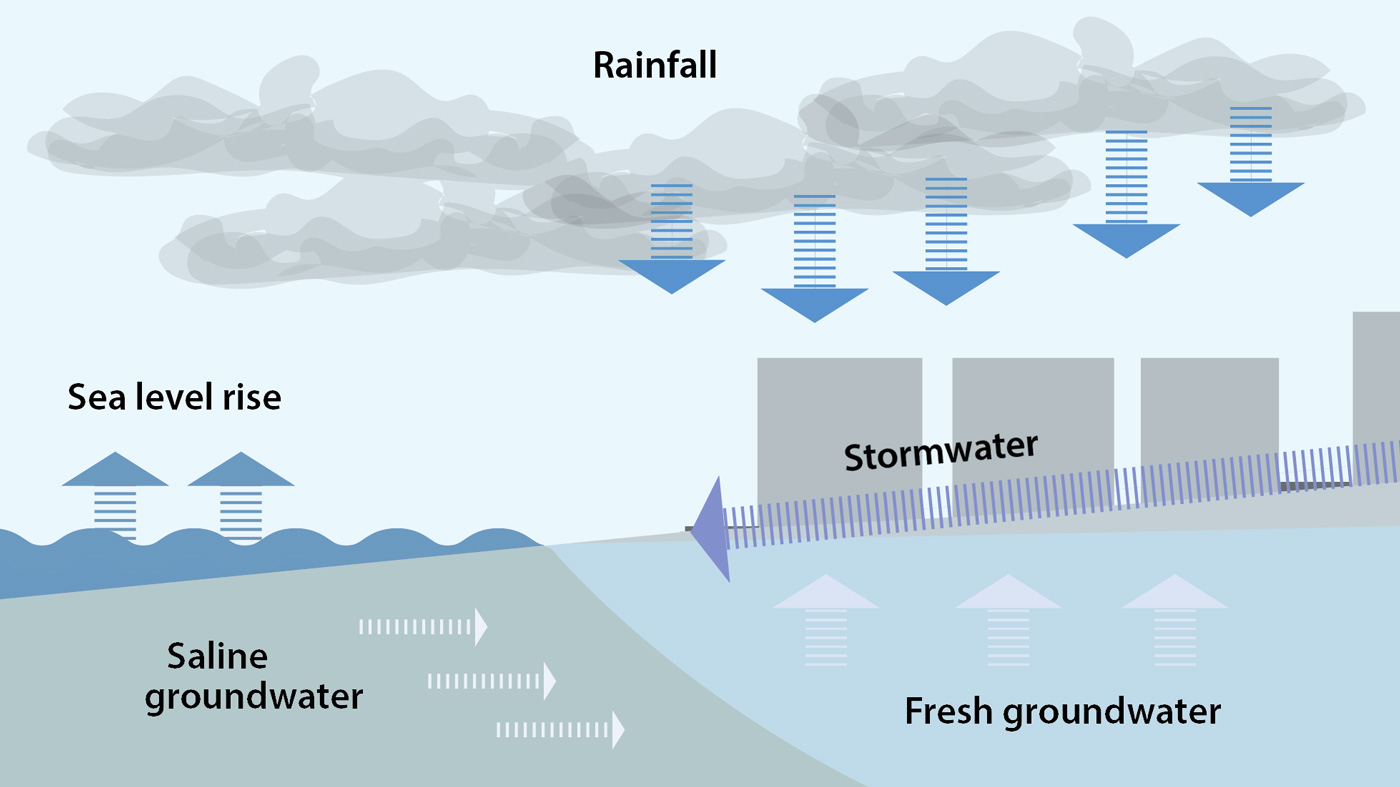
This graphic shows the directional flow and interaction between saline groundwater, fresh groundwater, stormwater, rainfall, and sea level rise (source: San Francisco Estuary Institute, 2025).
The Shoreline Plan will include two main outreach components: (1) a range of engagement strategies to reach the general public across the shoreline, and (2) a Shoreline Community Partners group with community-based organizations, advocacy groups, other jurisdictions, service providers, and others who can ground the work with their local knowledge.
Upcoming Events
There are no scheduled events at this time. Please stay tuned.
The project team is creating a plan for robust outreach and engagement, including public workshops, community events, public hearings, and more. The best way to stay up to date is by signing up for our mailing list:
Subscribe to Shoreline Plan Updates
Or email the team: CPC-ShorelinePlan@sfgov.org