
Pipeline Report
The San Francisco consolidated pipeline consists of development projects that would add residential units or commercial space, applications for which have been formally submitted to the Planning Department or the Department of Building Inspection (DBI). The pipeline includes only those projects with a land use or building permit application. It does not include projects undergoing project review or projections based on area plan analysis. Projects vary in size from single-units to larger multi-year development programs undergoing environmental review.
The Pipeline Report serves as a barometer of medium to long-term development trends. It illustrates location and scale of current and proposed construction taking place, and where new land uses are being established (as defined by the Pipeline Data dictionary); it also records demolition and a partial listing of conversion of existing land uses.
In sum, the pipeline provides a short- to medium-term picture of changing land uses, tracking especially the changes to the city's housing stock and commercial uses.
Projects in the Pipeline
Pipeline projects are at various stages of development: from applications having been filed to entitlements secured; from building permits approved and issued to projects under construction.
Once a project is issued a Certificate of Final Completion (CFC) by the Department of Building Inspection, it is taken out of the pipeline.
When all or a subset of residential units in projects receive a Temporary Certificate of Occupancy (TCO), those units are moved out of pipeline (removed from the “Pipeline Units” field), but projects stay in the pipeline until they receive a CFC.
Data sources for the pipeline are chiefly the project databases maintained by the Planning Department and the Department of Building Inspection, respectively, but data is also occasionally obtained from the Office of Community Investment and Infrastructure (formerly known as Redevelopment Agency).
2026 Q2 Housing Development Pipeline
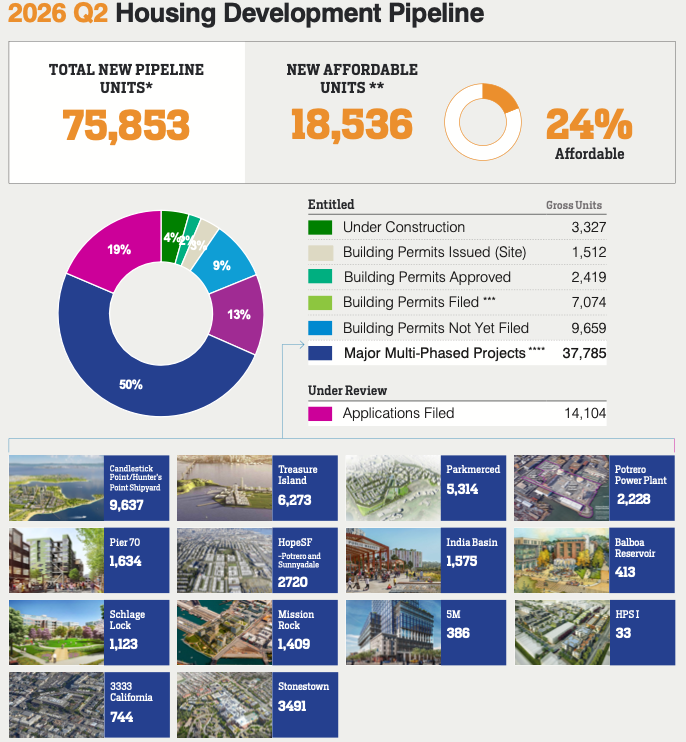
Total New Pipeline Units*: 75,853
New Affordable Units**: 18,536
(representing 24% of the total pipeline)
Summary Breakdown
- Under Construction: 3,301 (4%)
- Building Permits Issued (Site): 1,219 (2%)
- Building Permits Approved: 2,422 (3%)
- Building Permits Filed***: 7,856 (9%)
- Building Permits Not Yet Filed: 9,477 (13%)
- Applications Filed (Under Review): 13,036 (19%)
- Major Multi-Phased Projects****: 37,577 (50%)
- Total: 75,853
For projects and permits as of April, 2026.
Major Multi-Phased Projects
14 specific large-scale developments with their respective unit counts:
- Candlestick Point/Hunter’s Point Shipyard: 9,637 units
- Treasure Island: 6,273 units
- Parkmerced: 5,314 units
- HopeSF (Potrero and Sunnydale): 2,720 units
- Potrero Power Plant: 2,228 units
- Pier 70: 1,634 units
- India Basin: 1,575 units
- Mission Rock: 1,409 units
- Schlage Lock: 1,123 units
- 3333 California: 744 units
- Balboa Reservoir: 413 units
- 5M: 386 units
- Flower Mart: 3,532
- Stonestown: 3,491
* A project’s new gross units that is still in the pipeline; i.e. hasn’t yet received a TCO/CFC (proposed units - existing units + demolition units - TCO units)
** Includes estimated affordable units for projects subject to the Inclusionary Affordable Housing requirement (Planning Code Sec. 415) that have not yet determined how they will meet the requirement. Projects typically are not required to declare their inclusionary affordable housing program until entitlement.
*** Includes only entitled projects. Projects under review by Planning Dept with building permits filed but that do not require other types of planning entitlement are included in the “Application Filed” category.
**** Remaining phases of project. This does not include net units in phases that have filed for, or have received, building permits or are under construction.
While a pipeline report may show a ~4% uptick in the total number of affordable units, this is mostly due to two changes:
- Data clean up and using additional data sources (mainly Affordable Housing Pipeline) to fill-in data gaps on affordable units.
- Adding an estimate for the number of affordable units based on historical data for projects that haven’t yet determined how they will meet their inclusionary affordable housing requirements (e.g., on-site inclusionary units, off-site units, fee payment).
Dataset
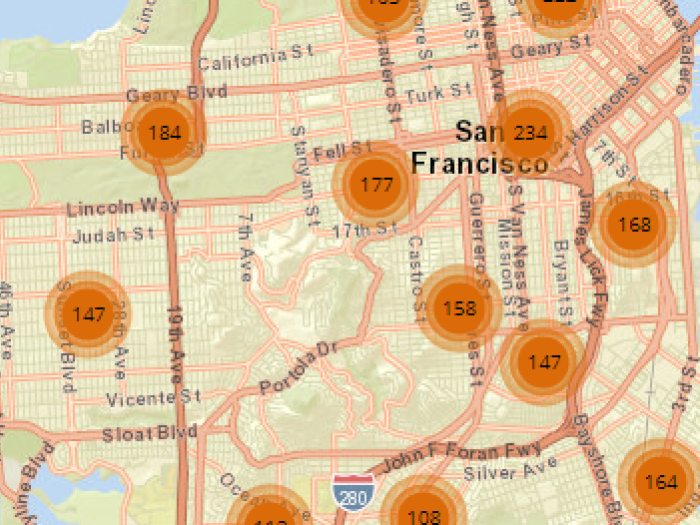
The full dataset and map of project locations are on the DataSF - Open Data Portal.
To request previous pipeline reports, please contact us.
Reporting and Timeliness
Significant data and systems improvements are underway to produce a more accurate quarterly pipeline, so the data may change at any time. Weekly and monthly data on Planning Applications and Building Permits can be accessed via the City's Open Data Portal:
- Planning Permits (updated weekly)
- Building Permits (updated weekly)
- Housing Completions (updated monthly)
Accuracy and Timeliness
The pipeline is compiled and consolidated from different data sources and is subject to errors due to varying accuracy and currency of original sources. The pipeline quarters are as follows:
- Quarter 1 (Q1): January 1 - March 31
- Quarter 2 (Q2): April 1 - June 30
- Quarter 3 (Q3): July 1 - September 30
- Quarter 4 (Q4): October 1 - December 31
The data in these reports are pulled from original sources. While we try to consolidate multiple permits for different components of the same project from different agencies, it is not possible to validate the accuracy of all projects.
Changes in Status Definitions
The following changes were made in status definitions since the 2022 Q1 Pipeline Report to align Quarterly Pipeline Reports with other Housing Reports (Housing Inventory and RHNA Annual Progress).
1. Construction: projects that are authorized for construction deemed to be in the construction stage. A project is considered to be authorized for construction if it has:
- an issued full building permit, or
- an issued site permit with an approved first construction document
Past definition: projects that had their first inspection were deemed to be in the construction stage.
2. Building Permit Issued: includes projects that have an issued site permit but don’t yet have their first construction document. Housing units These projects are not yet counted toward RHNA progress.
Past definition: included projects with any type of permit (site or full building permit) in the issued status.
Ken Qi
Planner
ken.qi@sfgov.org
628.652.7469
Data & Analytics Group
Administration Division