
SF Survey - Citywide Cultural Resources Survey
SF Survey identifies and evaluates places connected to San Francisco’s cultural life, architecture, and history.
The San Francisco Citywide Cultural Resources Survey, also known as SF Survey, is part of SF Cultural Heritage, San Francisco’s community-centered approach to recognizing and protecting cultural and historic resources.
SF Survey is how the City identifies and evaluates culturally, architecturally and historically significant places. This includes buildings, sites, and spaces that are connected to cultural life, social history, traditions, and everyday experiences. Places may be significant because of the people, communities, events, or traditions associated with them, or because of their architectural character and design.
By identifying these places, SF Survey makes the stories and histories that shape San Francisco more visible.
What is SF Survey?
In historic preservation, a survey is the process of gathering and organizing information about places so they can be better understood and considered in future planning decisions. SF Survey looks at places in their cultural, architectural, and historical context, not just as individual properties.
Survey work combines research, field work (on-site documentation and observation), and evaluation (assessing whether a place may qualify as a historic resource).
Survey work answers questions like:
- When was the place built?
- How has a place been used over time and how has it changed?
- Are there any special or unique qualities about this place?
- What communities or histories are connected to it?
- How does this relate to or contribute to its surrounding urban fabric?
- Why might it matter today?
This process results in survey findings, an inventory of properties that documents whether a place may qualify as a historic resource and explains why. Together, these findings help create a shared record of San Francisco’s cultural heritage. To learn more about SF Survey’s methodology, refer to the Methodology tab.
SF Survey does not happen on its own. It builds on Historic Context Statements, which help explain and document the histories and themes that are meaningful across the city. These contexts guide what types of places are looked for and how they are understood during survey work.
Survey findings also inform landmark designation, the City’s primary tool for formally recognizing and supporting the care of culturally, architecturally, and historically significant places. Only select surveyed places become landmarks, but survey findings provide important background that supports thoughtful and transparent decisions.
Together, these programs form a connected approach to understanding, identifying, and recognizing important places.
Community Knowledge
Community participation is essential to SF Survey. Lived experience, memory, and local knowledge help identify places that may not stand out based on architecture alone but are deeply meaningful to the people connected to them.
Community members help shape what is documented and how places are understood by sharing stories, participating in outreach activities, and reviewing in-progress findings.
For opportunities to participate in SF Survey, refer to the Get Involved tab.
Survey Phases
SF Survey focuses on different parts of the city over time, and the work is carried out in phases, typically focusing on specific geographic areas or themes. This effort combines fieldwork, research, and community knowledge to identify and evaluate places across the city. Survey phases are planned based on factors such as community readiness, progress on Historic Context Statements, and staff capacity.
To learn more about SF Survey Phases, refer to the Phasing tab.
Sharing Survey Information
Information about current and past survey areas, findings, and maps is available on the SF Cultural Heritage online platform, the City’s public website where community members can see what has been documented and how the work is progressing.
The platform serves as a living cultural resources inventory, designed to grow as new information is added over time. It allows the public to explore cultural heritage information and understand how places, histories, and community knowledge are connected across San Francisco.
The SF Survey uses a consistent, research-based approach to document cultural and historic places across San Francisco. The methodology ensures that information is gathered thoughtfully, applied consistently, and shared publicly in a clear and transparent way.
While the SF Survey is grounded in professional standards, community knowledge and lived experience play an important role alongside historical research and fieldwork.
Community Engagement
Click on diagram to enlarge.
Click on diagram to enlarge.
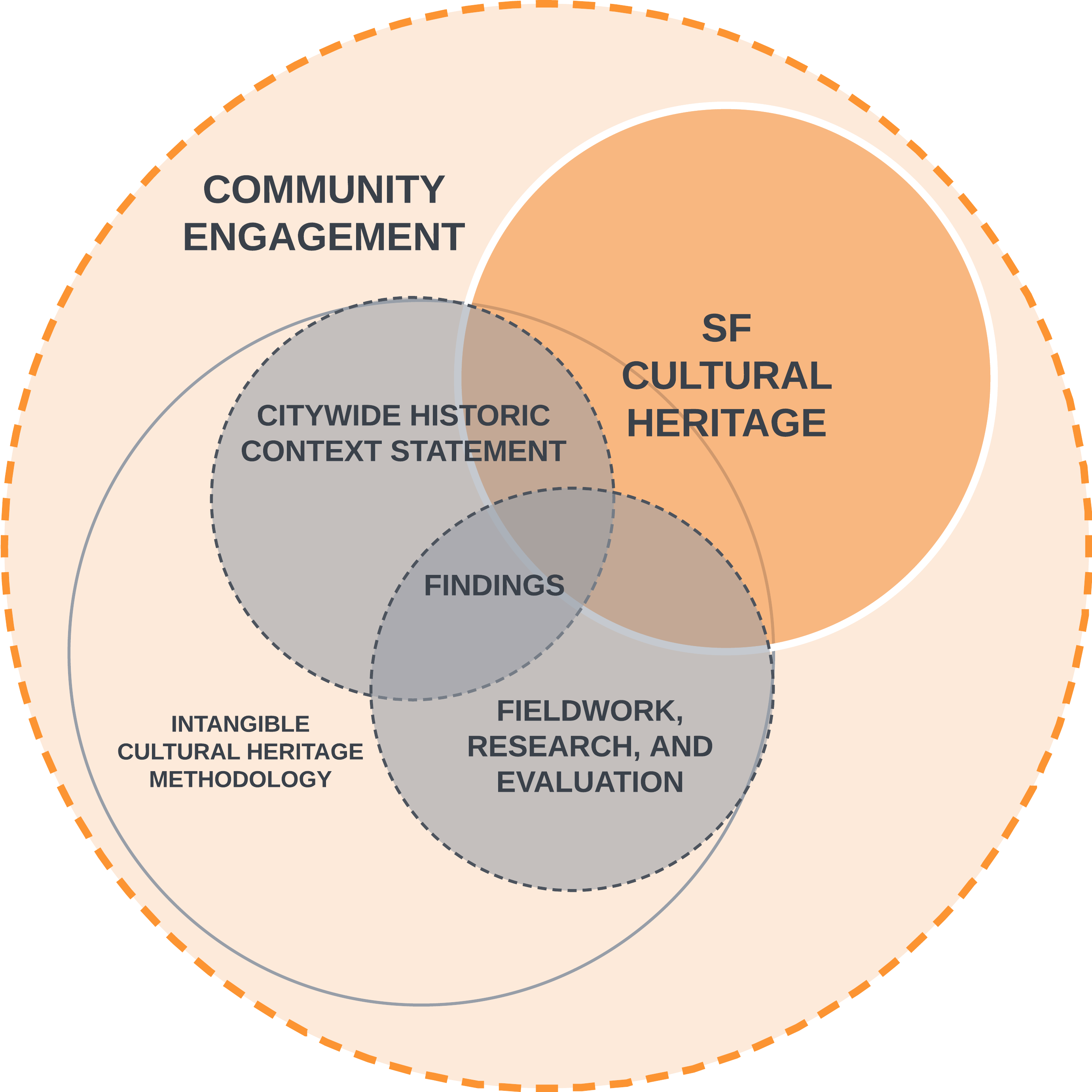
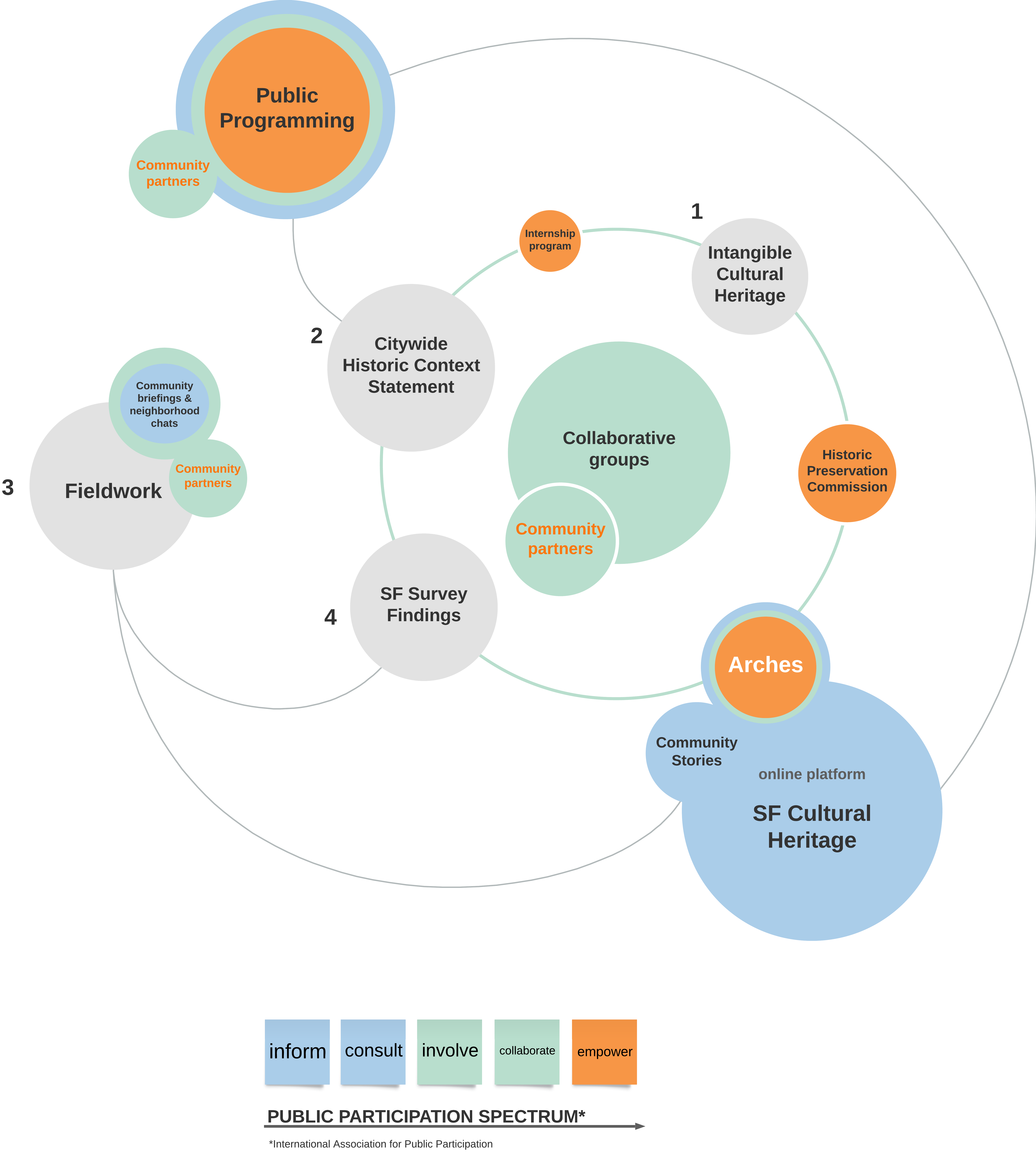
Community engagement is a core part of the SF Survey methodology. The Survey relies on input from community members to understand how places are used, remembered, and valued, especially in ways that may not be visible through architecture or written records alone.
SF Survey engagement builds on the Planning Department’s larger SF Cultural Heritage work, including approaches that recognize intangible cultural heritage, support community capacity-building, and use a range of engagement tools such as storytelling, interviews, mapping, and multimedia submissions. This approach helps ensure that histories important to communities are shared according to the priorities and preferences of those communities.
The SF Survey’s Community Engagement Framework was developed with guidance from community members and partners. It aligns with the Historic Preservation Commission’s racial and social equity resolution and focuses on building relationships with communities that have been historically underrepresented in preservation efforts.
Through this engagement, community knowledge directly informs research, documentation, evaluation, and review, strengthening the Survey’s findings and supporting inclusive outcomes.
Fieldwork, Research, and Evaluation
Survey work begins with fieldwork and continues through research and evaluation. Planning staff collect information about buildings, sites, structures, objects, cultural landscapes, and districts, and refer to the Citywide Historic Context Statement to understand how places connect to broader cultural, architectural, and historical themes.
SF Survey generally focuses on properties that are 45 years old or older, which is a standard threshold used to consider potential historical significance. Using historical research, field observations, and community input, staff evaluate previously unevaluated places to determine whether they may qualify as historic resources.
Survey work includes three main stages:
- Fieldwork documents existing conditions and how places relate to their surroundings
- Research gathers background information and community knowledge, typically through the Historic Context Statement process
- Evaluation brings together field observations, research, and community input to identify historic resources
In parts of the city where historic surveys were completed in the past, staff review and update earlier findings to ensure they align with current standards and reflect updated understanding.
How Places are Classified
As part of the SF Survey, properties are assigned a California Historical Resource Status Code, which indicates whether a property may be eligible for listing on the California Register of Historical Resources or the National Register of Historic Places.
For local planning purposes, these findings are simplified into two categories:
- Category A – Historic Resource Present
- Category C – No Historic Resource Present
These classifications inform planning and preservation decisions. They do not, by themselves, designate a property as a City Landmark.
Review, Public Hearings, and Adoption
The Historic Preservation Commission (HPC) holds public hearings on the adoption of SF Survey findings for individual properties. At each hearing, the HPC may elect to immediately adopt the findings with or without modifications, or they may take no action and direct the team to incorporate revisions or provide additional information.
Prior to those hearings, the SF Survey Team conducts outreach to share and discuss the context statement and/or findings of historic resource status with the community and key stakeholders.
Property-specific reports and detailed information are available on SF Cultural Heritage online platform, the City’s public website for accessing survey findings and cultural resource information.
Once draft survey findings are adopted, they are reflected in the San Francisco Property Information Map (SF PIM) and used during the historic resource review process for the California Environmental Quality Act (CEQA), building permit applications, development projects, and area plans. Staff also transmit a copy of the SF Survey Findings to the State of California Office of Historic Preservation and to the Northwest Information Center at Sonoma State University for reference.
The Planning Department considers Survey findings to be a "living" record and may further refine these findings to incorporate new information or address comments provided by the public, the Historic Preservation Commission, or California Office of Historic Preservation staff.
Over the next several years, SF Survey will occur throughout San Francisco and primarily concentrate on previously unevaluated, age-eligible properties across the city (45 years or older at the conclusion of the SF Survey). Department staff prioritize surveying areas that have been historically underrepresented in previous Planning Department studies. Phase locations are determined based on community readiness, historic context statement status, and staff capacity. Additionally, staff have been auditing evaluations throughout the city to ensure accuracy and conformance with current standards.
Phase 1: Neighborhood Commercial Districts
With the adoption of the San Francisco Neighborhood Commercial Buildings Historic Context Statement in 2022 and considering the certification of the Housing Element with rezoning efforts along commercial corridors on the west side of the city, Phase 1 of SF Survey fieldwork, engagement, evaluations, and findings focuses on neighborhood commercial districts (NCDs). NCDs are defined by the Planning Code and Zoning Map of the City and County of San Francisco.
- Fieldwork: completed in December 2024
- Engagement: underway
- Evaluations: underway
- Findings: underway
Phase 2: Supervisorial District 4
With the adoption of relevant historic context statements including the Sunset District Residential Builders, 1925-1950 Historic Context Statement and the Housing Element rezoning effort on the west side of the city, Phase 2 of SF Survey fieldwork, engagement, evaluations, and findings focuses on the residences, schools, libraries, churches, etc. in Supervisorial District 4 (all areas outside of the already-surveyed NCDs). This includes properties in the Sunset, Parkside, and Lakeshore neighborhoods.
- Fieldwork: started in March 2025
- Engagement: underway
- Evaluations: not started
- Findings: not started
Mapping
The current SF Survey phasing map is available on the SF Property Information Map (see "Active SF Survey Areas" under the Historic Preservation section). To track progress more closely, visit SF Cultural Heritage and click on "Overlays" on the right-hand side.
Timeline
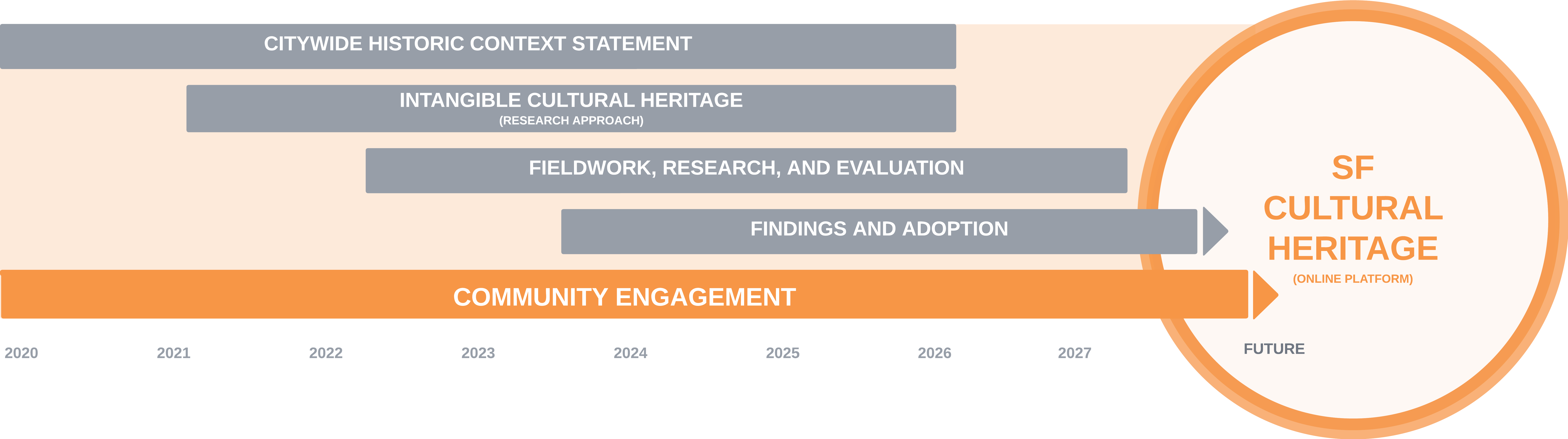
| Component | Schedule |
|---|---|
| Citywide Historic Context Statement | 2020 to 2026 |
| Intangible Cultural Heritage Methodology (research approach) | 2021 to 2026 |
| Fieldwork, Research, and Evaluation | 2022 to 2027 |
| Findings and Adoption | 2023 to 2027 |
| Community Engagement | 2020 to 2027 and beyond |
| SF Cultural Heritage (online platform) | 2023 and beyond |
| SF Survey Overall | 2020 to 2027 and beyond |
Timeline Diagram
Click on schedule to enlarge.
The Historic Preservation Commission (HPC) holds public hearings on the adoption of historic resource findings for individual properties in phases throughout the life of SF Survey. At each hearing, the HPC may elect to immediately adopt the findings with or without modifications, or they may take no action and direct the team to incorporate revisions or provide additional information.
Prior to those hearings, the SF Survey Team conducts outreach to share and discuss the context statement and/or findings of historic resource status with the community and key stakeholders. Property-specific reports and detailed information are available on SF Cultural Heritage.
Pending adoption, the SF Survey Findings are reflected in the SF Property Information Map and used during the historic resource review process for the California Environmental Quality Act (CEQA), building permit applications, development projects, and area plans. Staff also transmit a copy of the SF Survey Findings to the California Office of Historic Preservation and to the Northwest Information Center at Sonoma State University for reference.
The Department considers the SF Survey Findings to be a "living" record and may further refine these findings to incorporate new information or address comments provided by the public, the HPC, or California Office of Historic Preservation staff.
Phase 1: Neighborhood Commercial Districts
SF Survey Findings are available for the following areas:
Marina Neighborhood Commercial Districts
- Historic Preservation Commission Hearing, October 21, 2026
- Survey Findings Executive Summary, Draft Resolution with Map and Table, and Community Input Tracking Report
Haight Street, Cole Valley, and Divisadero Street Neighborhood Commercial Districts
- District Findings Map and Table
- Historic Preservation Commission Hearing, June 3, 2026
- Adopted Resolution R-1598 (June 2026)
- Survey Findings Executive Summary, Draft Resolution, and Community Input Tracking Report
West of Twin Peaks, Lakeshore, and Sunnyside Neighborhood Commercial Districts
- District Findings Map and Table
- Historic Preservation Commission Hearing, March 18, 2025
- Adopted Resolution R-1546 (March 2026)
- Survey Findings Executive Summary, Draft Resolution, and Community Input Tracking Report
Castro, Noe Valley, and Glen Park Neighborhood Commercial Districts
- District Findings Map and Table
- Historic Preservation Commission Hearing, December 17, 2025
- Adopted Resolution R-1506 (December 2025)
- Survey Findings Executive Summary, Draft Resolution, and Community Input Tracking Report
Outer Sunset and Parkside Neighborhood Commercial Districts
- District Findings (SF Cultural Heritage website)
- Historic Preservation Commission Hearing, May 21, 2025
Richmond Neighborhood Commercial Districts
- District Findings (SF Cultural Heritage website)
- Historic Preservation Commission Hearing, February 19, 2025
Japantown Neighborhood Commercial District
- District Findings (SF Cultural Heritage website)
- Historic Preservation Commission Hearing, October 16, 2024
Upper Fillmore Neighborhood Commercial District
- District Findings (SF Cultural Heritage website)
- Historic Preservation Commission Hearing, April 17, 2024
Inner Sunset Neighborhood Commercial District
- District Findings (SF Cultural Heritage website)
- Historic Preservation Commission Hearing, December 20, 2023
Share Your Story
Opportunities to participate in SF Survey work, attend outreach events, and review findings are announced as survey efforts move forward. Information about current survey areas, findings, and ways to get involved is available on this page.
Want to get involved? You can:
- Share Your Stories about places that matter
- Participate in surveys, interviews, and research
- Attend community events and public meetings
- Help identify cultural spaces, traditions, and sites
- Stay connected as this work continues
Sign up for Updates!
Receive news from the SF Survey project – this may include newsletters, events, and updates when there is important news to share. You may unsubscribe at any time.
Events Calendar
For the latest information on upcoming SF Survey related events, visit our calendar.
Get in touch by emailing CPC.Survey@sfgov.org or leaving a voicemail at (628) 652-7573.
RECIEVE UPDATES
Sign up to receive news from the SF Survey project. This may include newsletters, events, and updates when there is important news to share. You may unsubscribe at any time.